Showing posts with label Bump Baily. Show all posts

Wednesday, April 6, 2016

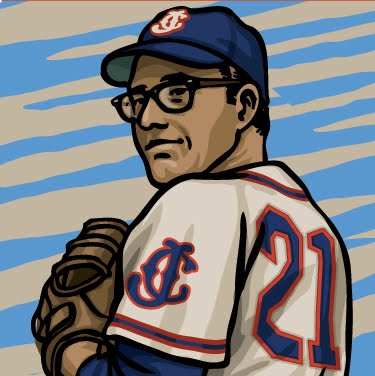
215. Al Fowler: The New York Knights Ace


After spending all that time researching and then illustrating real life Chicago Cubs Hall of Famers, I thought it would be a nice change of pace to pick a fictitious character from literature or movies. Because this is The Infinite Baseball Card Set and there are no set rules, guys like Mayday Sam Malone of "Cheers", Henry Wiggen from "Bang The Drum Slowly" and J.D. Salinger's Chief Gedsudski all take their place beside Babe Ruth and Mickey Mantle.

Bernard Malamud’s “The Natural” has always been my favorite baseball novel, and over the years I've created cards and back stories for two of the main characters, Roy Hobbs and Bump Baily. I thought today I’d create a card and biography for the New York Knights’ ace, Al Fowler.

Detroit Tigers scouts signed the 17 year-old Al Fowler right off the Rochester sandlots where he was regularly striking-out 15 batters per game. Rated one of the best pitchers in the minors, the New York Knights traded a handful of proven veterans to get the services of the young left-hander.Fowler debuted in the majors just before his twentieth birthday and he finished with a 3-1 record and what looked to be a promising future.

Fowler’s detractors say he tried to strike out every single batter he faced, there-by tiring himself out before the ninth inning. While this criticism may be true, it was something Fowler felt necessary due to the poor offence and defence provided by his Knights teammates. Contemporary sportswriters liked to quip that besides being among the leaders in strike-outs, Fowler also led the league in suspensions for breaking training rules. His late night cavorting with teammate Bump Baily was often cited as the only thing that stood in his way of becoming the best southpaw in the National League. Syndicated columnist Max Mercy famously described Fowler as “the 23 year-old who looks 30”.


Fowler’s luck turned around completely in 1939 when the 35 year-old rookie Roy Hobbs joined the Knights. With a potent offence finally behind him, the right-hander won a career high 15 games. He also picked up the win in the one-game playoff against Pittsburgh, though he pitched poorly. Rumors persist to this day about Fowler’s role in a plot by gamblers to “fix” the pennant, though he was never formally accused or prosecuted. Fowler tried to dispel any suspicions by pitching magnificently in the World Series, and his 3-hit shutout in Game 2 was the only Knights victory in the 5 game loss the Yankees.


Fowler suffered an arm injury warming up before the 1940 All-Star Game and never pitched effectively again. He was traded to the Cubs in 1942 and retired a year later. He worked as a salesman for the Ballentine Brewery and later owned a successful chain of liquor stores in the Rochester area.


Thursday, June 10, 2010

32. Bump Baily

Like many baseball fans, I was fascinated by the 1984 movie "The Natural" when it came out. The story was pretty mediocre and in fact it took me a few watches to realize that Glen Close's son was actually Roy Hobbs' son also. Maybe I was too busy paying attention to Kim Basinger at the time to fully comprehend such a slow curve of a plot twist. But anyway, the one thing that truly stands out is the great portrayal of baseball in 1939. I mean everything looked good, the uniforms, the outfield wall advertising, the stadiums, the way the ball players looked and talked, even the newspaper articles they showed close-ups of. It all looked absolutely fantastic. As a designer, I have to tip my hat to the artist that developed the uniforms for the fictional New York Knights because they looked like they would have been around in 1939. As someone who does graphic props for Hollywood, one of the hardest things for a movie designer to do is to get the right feel and look for a particular time period. So many details can throw the piece off like typeface, color, phrasing or style. So many movie sets fail to get the details right and it ruins the whole movie for nit-wits like me who spent way too many hours studying such minutia as typography and design history and wonder why the stupid artist couldn't do the same. But that's enough about films that didn't do it right because "The Natural" did.

I mentioned earlier about the mediocre plot. When I found out the movie was based on a book by Bernard Malamud I dug up a copy and read it expecting to read the same story as the movie. What a big shock, but it wasn't the same story. Not even close. The beginning was basically the same, young phenomenon on his way to a sure-thing tryout with the Chicago Cubs gets shot by a deranged psychopathic nymphomaniac. But now Malamud's Roy Hobbs becomes a dark, mean spirited jerk. He had a dishonest streak perhaps driven into him by the hard road he travelled after being shot and now that he has crawled his way back to the majors after 16 years he will let no one stop him in his quest to become the best there ever was. Robert Redford's Hobbs seemed like a nice guy, humbled by his experiences. Malamud's Hobbs is the opposite. He is just out for himself. Guy doesn't even like kids who ask him for his autograph. I won't spoil the rest of the book, because it will make a good, fast summer read for anyone who hasn't read it, but I will say the ending sure ain't like the movie!

Now back to the cards. I have been wanting to do a card of a New York Knights player and settled on one of Bump Baily. He was the Knights' star outfielder who died when he crashed through the outfield wall, paving the way for Roy Hobbs to get into the lineup. Bump was also a thug, womanizer and crooked. He was being bribed by the Knights owner to throw games so the team did not win the pennant. In the movie tough guy Michael Madsen portrayed Bump rather well. He had a rough voice and the proper thuggish attitude that the book described. When I decided to do a Bump Baily card, I made my depiction a hybrid of Madsen and another great slugger of the late 1930's - Joe Medwick. I leaned heavily on Medwick because he was exactly as I would picture Baily - a rough, mean and a powerful slugger. He was cocky because he was that good, he even won the Triple Crown in 1937. He was quick with is fists to the point of KOing his own pitcher during a game when he dared to criticize Medwick's error in fielding a ball. Teammate Dizzy Dean said of Medwick "Dawgonnit. That Medwick don't fight fair at all. You argue with him for a bit and then he beats you before you've even had a chance to speak your piece." (To set the record strait, Medwick was all these things BUT not a dishonest ballplayer.) For the fictional 1939 statistics on the card I went through some old newspapers and figured out what Medwick was batting in mid-May of '39, the time when Bump Baily met his demise in the outfield of Knights Field. The drawing leans heavily on the facial features of Michael Madsen combined with the scowl and slouching, cock-sure body language of Joe Medwick. The last thing was how to spell his name. In the book Malamud spells it "Baily" and in the movie it is spelled "Bailey". I like the story in the book better so I stuck with the original. Malamud must have had his reasons and who the heck am I to change it. So here you have it, Batholomew "Bump" Baily on his first and only baseball card.