


I don't like to get too personal about my life when writing this blog. I keep politics and all that stuff out because everyone comes here to read about baseball, not get a lecture or anything. However, life does get in the way sometimes, and I have to say this has been a rough couple of months for me and my family. My brother-in-law (and one of the groomsman at my wedding) passed away after a valiant battle with the very same cancer he spent his life researching. Then one of my closest and oldest friends decided that living was too much and took his own life. That's all I'm gonna say about all that except that those were among the reasons the content has been light over the last few months. I just wasn't all that inspired to write anymore.
But the other night a good friend of mine fired up that spark again.
My wife was in Oklahoma City with her sister's family and I was home alone. I called up my friend Vic and he crossed the river to my home in Kentucky to watch one of the Mets playoff games with me. As we walked to one of the local taverns here in Fort Thomas, Vic kept remarking how nice the town I lived in was. The streets were clean and tidy, people wave to you as you walk by and kids were out playing as the sun slowly went down. I couldn't help but agree, I do live in a special place.
That walk inspired today's story. The town of Fort Thomas is named for the military installation that still stands today. Though many of the buildings are gone, a good number still remain and the property is now owned by the city. The old water tower disguised as a Medieval stone parapet still guards the entrance to the fort. The tree lined streets that once reverberated with the sound of marching boots now allows walkers and joggers a picturesque setting in which to exercise. Many of the stately old officer's houses are restored and lovingly maintained by their civilian owners. The VA operates a large outpatient facility on the grounds and the old gymnasium is now open to the public. A small museum manned by enthusiastic local historians tells of the fort's past and a large playground entertains the children who will one day be the town's future. For a history buff like me it's a great place to wander around, and being a baseball fan, I looked for something to tie my two interests together.
I didn't have to look far. As recent as the 1968 Fort Thomas had a deep connection with baseball: Pete Rose and Johnny Bench did their Army Reserve duty at the fort serving with A Company of the 418th Engineering Battalion and you can find pictures of the heart and soul of the Big Red Machine peeling potatoes and doing KP duty in their fatigues.
But I like older stories so I dug deeper. Since the Civil War the U.S. Army embraced baseball. Not only was it a healthy activity for troops but it also instilled teamwork and regimental pride in the men. The 6th Infantry Regiment stationed at Fort Thomas on the Ohio River was no exception. In the 1890’s the regiment’s commanding officer was Colonel Melville Cochran. The Civil War veteran from Maine was an early and tremendous fan of the national pastime and had formed baseball teams at every post he was stationed, from Fort Apache to his new command in Northern Kentucky.
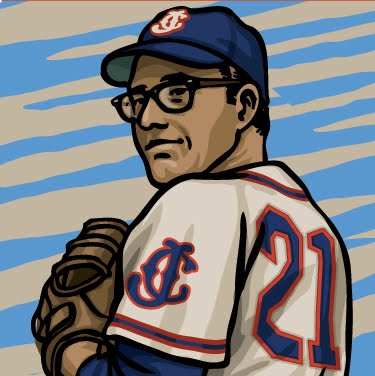
In tribute to the team’s founding father, the 6th Infantry club was named The Cochrans and the men’s jerseys bore their patron's name in bold letters across their chests. The Colonel’s dedication to the team’s success as so complete that he was known to order key players locked up in the brig the night before a big game to ensure their sobriety. He also turned a blind eye when the fort's provost let members of the team out of the brig to participate in a big game.
A large part of the Cochran’s success was that big league ballplayers who lived in the area used the Fort Thomas’ large indoor athletic facilities to keep in shape over the winter. Connie Mack, Bill Wilson and Jesse Tannehill were among the players who used the indoor batting cages and equipment. In return, the Cochran’s benefited from being coached by real major leaguers. This impressive athletic hall still stands on the grounds of the old fort and still serves in its original capacity as a community gym.
Throughout the 1890’s the Fort Thomas Cochrans fielded the best baseball team in the U.S. Army until 1898 when the regiment left to fight in Cuba. The star of the Cochrans during their heyday was a sergeant from Baltimore named John Thomas Grimes. A veteran of the Sioux Indian War, it’s not known when Grimes began playing baseball, but by the time he was posted to Fort Thomas he was a talented twirler.
When not hurling for the Cochrans, Grimes hired his services out to teams as far away as Indiana when they needed a professional arm. He made headlines in 1894 when he whipped the Cincinnati Reds of the National League while pitching for the semi-pro Newport Reds.
In 1897 Sergeant Grimes wrangled four months of leave and began playing minor league ball in Evansville, Indiana. He was an instant success and became extremely popular with the Evansville fans - so much so that he acquired a "groupie", Rose Stewart, who cause a sensation by leaving home to follow the dashing soldier on a road trip. The scandal made all the Indiana papers and Grimes was momentarily accused of wrong-doing but quickly cleared when it became known he hadn't encouraged Rose's affections. Seems Miss Stewart was a bit of a Victorian hell-raiser and perpetual runaway.
By the end of the summer Grimes, now called “Soldier Boy”, had made it all the way to the majors with the St. Louis Browns. On July 31, 1897 Grimes made history by hitting a record six Louisville batters in one game - though to be fair it appears that he did it on purpose! Apparently there was some bad blood between the two clubs and Grimes was dishing out some retribution. In all he pitched 3 games in the majors, lost 2 and had an admirable .286 batting average. After his leave was up, Grimes returned to the army where he served in the Spanish-American War and World War I before retiring with the rank of captain.
As an interesting side note, you might have noticed that I obscured Grimes' face. See, John Grimes is one of the only men to play in the Major Leugues of whom there is no known photograph. I was rather shocked by this as not only did he play minor league ball and was quite popular but he was a wildly sought after semi-pro mercenary. On top of that he was a soldier for more than 40 years, surely there is a photo of him somewhere? Enjoying a good hunt, I scoured the local archives for hours on end. At the Fort Thomas Museum I found a team photo of the Cochrans - but Grimes was absent that day! So the search continues. Hopefully some day I can revise his portrait, dropping his hands to his side and re-introduce the face of the man who made Rose Stewart leave home back in 1897...
Those who have met me in person know I'm not the kind of guy to toot my own horn. In fact, much to my detriment, I'm lousy about promoting myself. That's why it's hard for me to ask this, but this is something that needs to be done: if you bought a copy of The League of Outsider Baseball, can you please take the time to write a review of it on Amazon, Barnes and Noble or Good Reads? It would mean a lot to me and most importantly give future publishers an idea of what the book reading public thinks of my work. Almost all of the existing reader's reviews have been flattering, but every once in a while some crackpot writes a clunker out of jealousy or boredom. I for one often look at the reviews on those sites before I spend my money on a book. Reviews aren't the only thing I rely on in my purchasing process but it's certainly a factor, and that's why I'm asking you to please take the time to write your thoughts about my work.

