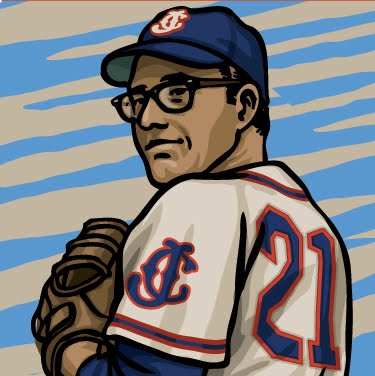
A few months ago Larry Blakely wrote to me suggesting Artie Wilson, last of the .400 hitters, as a suitable candidate for The Infinite Baseball Card Set. Larry spelled out Wilson's credentials - a key member of the Negro League Champion Birmingham Barons, one of the first blacks to play in the majors, teammates with Willie Mays both in the Negro and Major leagues, a legend in Puerto Rico for his batting prowess and all-around fan favorite in his later years in the minors out on the west coast. As if that wasn't enough to convince me that Artie Wilson did indeed deserve a place on this site, Larry also sent along a copy of an article he'd published a few years ago about Wilson. After reading it I instantly knew that no one was better qualified to write about the subject so I asked Larry if he'd consider letting me run his article as-is along with a card I illustrated. Larry graciously agreed, updated the earlier published piece with some new tidbits, and, well, here it is...
Almost every baseball fan knows Jackie Robinson broke Major League Baseball’s color barrier in 1947. Less well known is the fact that integration of baseball thereafter was a slow process, taking far longer than it should have. After Robinson joined the Brooklyn Dodgers, the door of opportunity for African American players was ajar but not yet fully open, the stream of blacks entering the majors was initially more like a trickle.
True, the integration of baseball was faster than the glacial “all deliberate speed” of school desegregation in America that began in 1954. Nonetheless, for several seasons after Robinson’s breakthrough, tapping into the existing pool of talented Negro League veterans was more sluggish than swift. For reasons ranging from simple to complex, clear to obscure, many star players didn’t get the call. Some, like Josh Gibson in 1947, had died young. Some, like James “Cool Papa” Bell, had played their best ball a decade earlier. And some, though clearly qualified to play in the major leagues, had a break or two go against them. Case in point: Artie Wilson.
In July of 1959 the Boston Red Sox became the last major league team to shake its Jim Crow heritage and include an African American on its roster. Elijah “Pumpsie” Green modeled his game after a speedy shortstop who played professionally for the Oaks in nearby Oakland when Green was growing up. His name: Artie Wilson.
Who was the last big leaguer to hit .400? No, it’s not that Red Sox slugger who ended the 1941 season with a .406 batting average. It was a different left-handed hitter known for knocking line drive singles to the opposite field. The year was 1948 (Ted Williams only managed a paltry .369 that year). The player: Artie Wilson.
1948 was a very good year for Arthur Lee Wilson. Besides hitting .402 in the regular season and winning his second batting title in a row, he played in the East-West All-Star game as well as the Negro Leagues World Series. After the Series he went to Puerto Rico for winter ball where he led the Mayaguez Indians to a Cuban league title, hitting .379. Oh yeah, in 1948 Wilson also met Dorothy Daniels, the manager of a Birmingham record store, and later left her tickets for a game. Turned out she and her father were big baseball fans. The following year “Dotty” became his bride.
Artie Wilson first played professional baseball in 1944-48, five seasons with the Birmingham Black Barons. Four times he was selected to play in the All-Star game, a huge event in black baseball that usually drew 40,000-50,000 fans to Comiskey Park. The only year he missed, 1945, the shortstop chosen was a rather talented Kansas City Monarch rookie, Jackie Robinson. Wilson played in the Negro Leagues World Series three times, including the final one in 1948, each time losing to the powerful Homestead Grays. “Those guys could play,” Wilson said in a classic bit of understatement. “Even their pitchers could hit.”
1948 was also the year that a fellow Alabama native, 16-year-old Willie “Buck” Mays, joined the Black Barons. Wilson, who had once played against Willie’s father “Cat” in Birmingham’s semipro industrial league, said the elder Mays was a terrific all-around player who covered center field like a tarp. “He’d played real shallow, practically in the infield,” he recalled, “but he could run down anything hit his way.” In fact, in his entire career, Wilson says he never saw a player better than Willie Mays Sr. though he conceded son had better home run power than dad. Wilson’s wife said her husband was like a second father to young Willie. In 2006 the Wilsons attended a banquet in Beverly Hills where Mays honored four surviving Black Barons teammates. He said his Birmingham mentors knew he could, with a little guidance and a little luck, play in the majors. “What they did for me, I’ll never forget.”
In the spring of 1949, two years after Jackie Robinson made sports history, it appeared Wilson was likewise headed to the major leagues.
The Cleveland Indians, after winning the 1948 World Series with Larry Doby, the American League’s first African American player, and an aging yet ageless Satchel Paige on their roster, purchased the rights to Wilson from Barons president Tom Hayes Jr. In February of 1949 Cleveland’s flamboyant president Bill Veeck personally flew to Puerto Rico to sign Wilson, 28, who they had been scouting for a year. Earlier, between the regular season and winter ball, Wilson had barnstormed with Satchel Paige’s All-Stars, playing Bob Feller’s white All-Star team in venues all over the country. In addition to Rapid Robert, he hit against top pitchers such as Warren Spahn, Bob Lemon and Spud Chandler. So when he arrived at the Indians’ Arizona spring training site in 1949, a confident Wilson commented, “I’ve hit major league pitching before. I think I can do it again.”
1949 was also the year the New York Yankees signed a raw talent from Oklahoma who could likewise get wood on a baseball: Mickey Mantle. Unfortunately, the Yanks also thought they had secured the rights to one of the Negro Leagues brightest prospects: Artie Wilson.
New York General Manager George Weiss, sounding very much like he’d just eaten a large serving of sour grapes, claimed Veeck’s signing Wilson was unethical if not illegal.
To the middle infielder caught in the middle who simply wanted a chance to play Major League Baseball, the controversy was difficult to fathom. “New York made me an offer. I didn’t accept it,” Wilson told a newspaper reporter. “Cleveland came along with another offer. I liked it. I accepted it and signed. That’s all there is to it.”
Well, so it seemed.
Except the Yankees, being the Yankees, weren’t about to let a rival best them in the pursuit of new talent. They were probably still stinging from Cleveland’s taking the 1948 World Series title, a title held the previous year by the Bronx Bombers (and for five consecutive years starting in 1949). The fight for Wilson wound up in the commissioner’s office for resolution. At the same time a second contract dispute developed between the Indians and Yankees involving former Negro League outfielder Luis Marquez who, unlike Wilson, had signed with New York. In biblical times, King Solomon threatened to split the baby. In this case, baseball commissioner “Happy” Chandler switched the players. He voided both contracts, sending Marquez from the Yankees’ farm club in Newark to the Cleveland organization and Wilson to Newark. Unhappily, neither player would make it to the majors for another two years.
Truth be told, in those days the Negro Leagues owners knew, with integration finally becoming a reality, their teams’ days were numbered. Some were less than straightforward with both their own players and the major league teams seeking to sign their best players. So it’s possible Hayes, unbeknownst to Wilson, conveniently backed out on the Yanks when a better offer came along. Or the Yankees simply muscled the commissioner’s office into wiping out a legitimate deal. Or perhaps Chandler was pushing his own hidden agenda.
In any event, after the decision was announced, the Yankees promptly traded Wilson to the Oakland Oaks of the Pacific Coast League where he played his first season of integrated ball one year after the PCL color barrier was broken.
One day a cocky second baseman arrived and overheard someone mention that Wilson didn’t have a roommate. “Yeah, he’s got a roommate,” said 20-year-old Billy Martin. “I’m his roommate.” Wilson fondly recalled Martin was both a good player and a good person. In those days, of course, it was not exactly common for teammates of different races to share a room on the road. Although the fiery Martin matched with the even-tempered Wilson seems an odd couple, Wilson said they—sharing a passion for the game—got along great.
That year Wilson quickly became the Oaks most popular player while topping the league in both hitting (.348) and stolen bases (47). After the 1949 season, the Yankees bought the rights to second baseman Billy Martin. Yet it was another year, during which he helped Oakland win the 1950 pennant, before the shortstop who played next to Martin got an opportunity to move up. It was not the Yankees but New York’s Giants who signed Wilson, and in the spring of 1951 it appeared he was finally going to be playing on major league diamonds. In Florida, he shined in spring training, once collecting 5 of the Giants 11 hits in a game. In one of his typical at-bats reflective of the faster, more freewheeling style of the Negro Leagues, Wilson laid down a bunt and rocketed to first, stole second and then scored on a single. During a short barnstorming tour after spring training, Wilson had a team-high .480 batting average.
Well into his 80s, Negro League veteran, New York teammate and Hall of Famer Monte Irvin retained an encyclopedic memory of his baseball career. He compared Wilson to major leaguer Ichiro Suzuki and said, “You couldn’t get Artie out. As soon as his bat hit the ball it seemed like he was already halfway to first base.” Irvin added, “Artie was great in the clubhouse. He kept us loose and laughing, always had a joke to tell. That’s why Leo Durocher loved him so much.” Heading into the regular season, an April 3 New York Times headline touted the versatile Wilson as being slated for a regular berth. In fact, when asked about the highlight of spring training, Giants manager Durocher said, “This fellow Wilson. In my book he has been terrific and I don’t see how I’m going to keep him out of the line-up. A fellow who can field and hit the way he can is going to take somebody’s job, make no mistake about that.”
It never happened.
On the road toward full integration of the game, at the intersection of talent and opportunity, Wilson hit a roadblock. After the regular season started Wilson played only sparingly for the Giants, getting only 22 at bats in 19 games, sometimes as a pinch hitter, other times while playing second or even first base. He once commented, “The only time I got into a game was when somebody got hurt or kicked out.” One day Durocher, who Wilson admired in spite of “The Lip” routinely stealing his cologne while he was in the shower, asked him to play center field. According to a newspaper account, Wilson replied, “You’ve got the best center fielder in baseball down in Minneapolis. Why don’t you get him up here?” Indeed, a 20-year-old on the Giants’ farm club was torching AAA pitching at a .477 clip after 35 games.
Willie Mays was called up. After initially batting a less than spectacular 1-for-26, he soon became, well, Willie Mays. And to make room on the roster for the Say Hey Kid, Wilson was sent down. Thus a dependable leadoff man who consistently hit well over .300, a speedster who ran like a cheetah on caffeine, a slick-fielding shortstop who had a strong arm and a soft glove, a player who was popular with fans and players alike, was gone.
After Bobby Thomson hit his famous Shot Heard ’Round the World in a playoff against Robinson’s Dodgers, that Giants team went on to the World Series in 1951. They lost to a Yankees squad that included Joe DiMaggio in the twilight of his career and a blond rookie on the ascent, Mickey Mantle.
As for Wilson, was it simply bad luck because the Giants younger shortstop and co-captain, Alvin Dark, was in his prime? A lack of home run power? Concern that the 31-year-old’s stellar skills might soon decline? Or another possibility that can neither be proved nor ruled out: an unwritten racial quota in play behind the scenes. This much is known: in 1951 only six of the 16 major league teams carried at least one African American player on their rosters. A few owners like Veeck aggressively pursued Negro Leaguers, whereas other teams were more interested in bringing a young black player along through the minor league ranks than signing an established veteran. And some simply and steadfastly maintained a certain uniformity of skin color. With Mays in uniform, the 1951 Giants were also about to field the first all-black outfield in major league baseball and had another African American, catcher Ray Noble, on the roster. A cynic might wonder if someone in upper management was a bit twitchy about the team becoming too dark too fast.
Instead of playing for Giants minor league clubs, Wilson—with Dotty’s blessing—eventually decided to return to Oakland where he earned more money than his major league salary and, even more importantly, could play every day. Major league cities only went as far west as St. Louis until 1959, and in the ‘50s the PCL was often called the third major league as its level of talent was nearly on a par with the major leagues. Upon his return to Oakland Wilson was greeted by a big floral display purchased by fans. His first game back, attendance was four times greater than a normal weeknight crowd. Like the previous two seasons, hordes of youngsters waited after the game to get his autograph, and the friendly shortstop always accommodated the fans.
Wilson hit over .300 each of his first four years after returning to the Pacific Coast League and earned three more batting titles. Obviously his skills had not eroded. But he never again got a look with a major league club. Wilson finished his career in the PCL in 1957 after playing for the Oaks, Seattle Rainiers and Portland Beavers. In an odd twist, the 1955 Beaver team included a couple of former Negro League stars, Luis Marquez and Artie Wilson. And 1955, by the way, was also the first year the Yankees fielded an African American player, Elston Howard. Two years earlier, Jackie Robinson had publicly questioned whether the Yankees had an unwritten pigmentation policy. In a follow-up magazine article, the front office strongly denied it. But their scout who had earlier passed on Willie Mays was quoted, “I got no use for him or any of them. I wouldn’t want any of them on a club I was with.” Policy or no, I’m guessing he wasn’t the only scout to harbor such views.
For over 50 years the Wilsons lived in Portland, Oregon, where they raised two children and Artie sold cars for many years after his professional career was over. Wilson never really left baseball, however, and when he still played in old-timers games in his 70s, the 5’ 11” former shortstop remained within a pound or two of his 163 pound playing weight. At age 85, the man who “loved to hit” threw out the first pitch when the Yankees played the Mariners in Seattle. When asked what would happen if he stepped into the batter’s box, his eyes lit up, he flashed a sly smile and said, “Well, I wouldn’t be leaving the bat on my shoulder, that’s for sure.”
Some 60 years after the fact, Wilson received official recognition for his Negro League stardom. The ESPN Baseball Encyclopedia named him both Rookie of the Year and Most Valuable Player in the Negro American League for 1944. In addition, historian John Holway’s Complete Book of Baseball’s Negro Leagues named Wilson and Marquez winners of the Fleet Walker Award (MVP) for their respective leagues in 1947. “There have been only two geniuses in the world,” actress and notorious free spirit Tallulah Bankhead once said, “Willie Mays and Willie Shakespeare.” A few years ago Mays told an audience, “Artie broke me in. I wish I could somehow pay him back.”
A few centuries ago that other Willie wrote, “Let us not burden our remembrance with a heaviness that’s gone.” By these words Artie Wilson lived, happy in the moment, unfettered by regret. Some have speculated that Josh Gibson’s fatal stroke at age 35 was due in part to heartache after being passed over by major league baseball in favor of Jackie Robinson. If in fact the man known as the black Babe Ruth was haunted by thoughts of what might have been, this definitely cannot be said of Wilson. The mild-mannered player who was never—not once—tossed from a ball game, was completely comfortable in his own skin, fully satisfied with the way things turned out for him both within and without baseball.
Still, one fact is inescapable: in slightly different circumstances he could have played for the Indians with Bob Feller and Satchel Paige. Or the Yankees with Mickey Mantle and Billy Martin. Or the Giants with Willie Mays and Monte Irvin. But Wilson was definitely not one to waste time on idle speculation, not inclined to curse the baseball gods (or owners, if they are different), not the sort of man to bemoan a tricky curveball of fate. Sure, early in his career he was forced to play in the shadows of segregated ball due to a nation’s shameful racism. And for four seasons post-Jackie Robinson, he didn’t get a shot at the major leagues. His typically tranquil reaction, per one newspaper account, “Why be angry about it? There’s a time for all things. It just wasn’t the time.”
Several years ago, following a lengthy discussion about his playing days, Wilson stood on the porch of his comfortable Portland home and gazed down the tree-lined street where he and Dotty lived for a half century. Finally, in a voice scarcely more than a whisper, he said, “Those were some good old days.” A pause. “I had a nice career. That’s good enough.”
Playing across the U.S. and Latin America against some of the all-time best players, both black and white. Batting and stolen base titles. Negro Leagues World Series. Multiple pennants. Pacific Coast League Hall of Fame. All-Star. Rookie of the Year and Most Valuable Player, albeit belatedly. Mentor to Willie Mays. Last of the .400 hitters.
For Artie Wilson, good enough was plenty good. The last of the .400 hitters died in October 2010 a few days after his 90th birthday.
A Little About the Author... Before he retired, Larry Blakely wrote sports for a number of publications including Chicago Sports Weekly. Dust and Dreams, his collection of short fiction, is out of print but he hopes to bring it back soon as an e-book.



 From
the moment he perched his front foot onto the top step of the dugout at
Rickwood Field, Piper's personality had a pull on his players. He
understood how to be their teammate and their manager. He drew lines. He
was a married man and so he did not partake in the nightlife. He did
not drink or use profanity. The years after 1947 were a trying time for
Negro League players, who could see their once proud league dying a slow
death, and who recognized that the white majors were not in a hurry to
sign them all despite the successful arrival of Jackie Robinson.
From
the moment he perched his front foot onto the top step of the dugout at
Rickwood Field, Piper's personality had a pull on his players. He
understood how to be their teammate and their manager. He drew lines. He
was a married man and so he did not partake in the nightlife. He did
not drink or use profanity. The years after 1947 were a trying time for
Negro League players, who could see their once proud league dying a slow
death, and who recognized that the white majors were not in a hurry to
sign them all despite the successful arrival of Jackie Robinson. 

