Showing posts with label Boston Red Sox. Show all posts

Monday, December 7, 2015

209. Tris Speaker: Fenway Park, 1912


Over the past two weeks I've unveiled two of my commissions for The National Pastime Museum: my interpretation of "Casey at the Bat" and Grover Cleveland Alexander. The third and final piece commissioned was of Hall of Famer Tris Speaker. 


Speaker had a long, illustrious career, first with the Boston Red Sox when they won the World Series in 1912 and 1915, and then with the Cleveland Indians where he led the Tribe to the 1920 World Championship. When Speaker wrapped up his career in 1928 his average was frozen at .345, still sixth best of all-time. He holds the record for career doubles and ranks fifth in total hits. As powerful as Speaker was at the plate, he truly excelled in the outfield - beat writers at the time gave his glove the coolest description ever bestowed on an inanimate piece of sporting equipment - "the place triples go to die". 

As good as he was on the playing field, Tris Speaker also had a dark side. As a young player with Boston he was mixed up in the Catholic vs. Protestant rivalry on the team, something he brought with him when he moved to Cleveland in 1916. His anti-Catholic feelings were so strong that he refused to attend his friend Ray Chapman's funeral after he was killed by Carl Mays' erritant pitch in 1920 because it was in a Catholic church. Sportswriter Fred Lieb wrote in his book "Baseball as I have Known It" that Speaker revealed he was a member of the Ku Klux Klan. Still, when Larry Doby joined the Indians in 1947, Speaker was a scout/good will ambassador for the club and reportedly displayed complete support for the AL's first Black ballplayer.  

Speaker's career in the majors ended under a dark cloud in 1926 when he and Ty Cobb were implicated in a game-fixing scandal by former teammate Dutch Leonard. An investigation by Commissioner Landis ultimately found nothing to it, but by the time he was cleared Speaker was out of the majors and managing in minor leagues. Scandal or no scandal, Tris Speaker left behind such impressive numbers that nothing could possibly stand in the way of his enshrinement in Cooperstown.

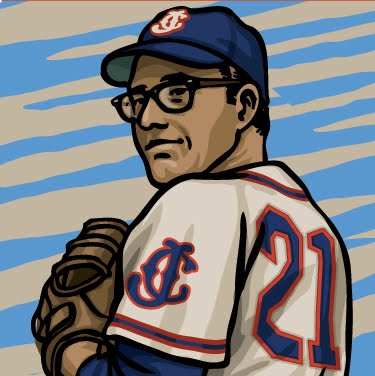
For my illustration I wanted to do something that visually popped. I went through my library and found a photo postcard of a player wearing a 1911-1912 Red Sox warm-up sweater. Made of red and white wool, that thing must have popped in real life. the time period worked well, too. 1912 was Speaker's first really great year in majors as he helped bring Boston a World Championship - and even better - 1912 was the inaugural year for Fenway Park. 

So, allow me to introduce Tristram E. Speaker, Fenway Park, Fall of 1912...


I'd like to thank The National Pastime Museum for the commission of these three pieces. On top of being a lot of fun to research and execute, it is a great honor to be part of their permanent collection of baseball art.


Those who have met me in person know I'm not the kind of guy to toot my own horn. In fact, much to my detriment, I'm lousy about promoting myself. That's why it's hard for me to ask this, but this is something that needs to be done: if you bought a copy of The League of Outsider Baseball, can you please take the time to write a review of it on Amazon, Barnes and Noble or Good Reads? It would mean a lot to me and most importantly give future publishers an idea of what the book reading public thinks of my work. Almost all of the existing reader's reviews have been flattering, but every once in a while some crackpot writes a clunker out of jealousy or boredom. I for one often look at the reviews on those sites before I spend my money on a book. Reviews aren't the only thing I rely on in my purchasing process but it's certainly a factor, and that's why I'm asking you to please take the time to write your thoughts about my work.


Wednesday, October 17, 2012

133. Melo Almada: Not quite Mexican, Not quite American

My girlfriend, who happens to be as much of a degenerate baseball fan as I am, casually asked me one night "when did it become bad form to bunt to try to break up a no-hitter?" 

The reason she brought that up was earlier this season Justin Verlander of the Tigers was throwing a no-hitter against her L.A. Angels. Erick Aybar tried to get on base by laying down a bunt in the 8th inning. Fundamental baseball, right? Not to Verlander. Detroit's ace was pissed someone would dare try to put his no-hitter in jeopardy. He went so far as to call Aybar a "bush-leaguer" for trying to get on base and get the Angels moving. Apparently "big leaguer" Verlander thought a no-hitter was something the other team was just supposed to hand over to you after a certain amount of innings had been played. What is that magic inning number? The 7th? 8th? What is it? 

When did baseball become like youth soccer? Maybe Verlander should be playing right wing or some other stupid position on a community soccer field somewhere. In my opinion, if you can't deal with a bunt in the late innings then you don't deserve a no-hitter - you don't even deserve to wear that Detroit ball cap. Bush league. Hell, with an attitude like that Verlander should just pull up his socks, pull on some ad-riddled polyester jersey and hit the soccer field. At least between the goals no one will call you a sissy if you fall down and writhe around in pain if you get bumped.

It used to be that baseball was a tough sport. The outfield walls weren't padded. Guys slid hard into a base and someone in the opposing dugout always found something in your ethnic background to needle you ceaseless with. You broke up a double play with your body and every time you stepped up to the plate the chances of having an 82 mph fastball thrown directly at your head was frightfully good.

It was a tough game and unfortunately, it wasn't always for everyone, no matter how good they were. So that brings me to Melo Almada, the first Mexican-born ball player to make it to the majors.

He was born Baldomero Almada Quiros but everyone called him Melo or Mel. He was recklessly handsome, olive skinned with a thousand watt grill that made the broads go limp. He was musically inclined and his travel luggage included a state-of-the-art radio which he immediately installed in each hotel room, keeping up with the newest hits. His manners were as impeccable as one of those mustachioed stars you saw in a Hollywood musical. And he was a heck of a promising young ballplayer.

His Pop was the Mexican Consul in Los Angeles, a position he accepted because the governorship of Baja California he was initially posted to came with an incumbent who didn't seem to want to vacate. The hundred-man private army he surrounded himself with made any attempt at collecting the keys to the governor's mansion seem, well, stupid. And Melo's father was anything but stupid.

The Almada's traced their lineage right back to Spain and countless "Dons" and "Donas" dangled from the family tree. By the time Almada Senior was handed the Baja governor's job his family controlled silver mines and their vast land holdings amounted to the size of Belgium. When the Mexican revolution broke out in 1910 the Almada's and their wealth became a prime target of the angry peasants and quite a few Almada's were victims of the violence that Mexico descended into. So in 1914 when Almada Senior realized the odds of him becoming governor of Baja was a certain death wish, he wisely realized the time had come to get the heck out of Mexico. 

Melo was but a year old when the family settled in Los Angeles. Both he and his older brother Lou quickly adapted to life in America and of course that included baseball. Their father also developed a passion for the game and encouraged his boys to play the sport. Lou was good enough that he turned pro in 1927 and within a year was well on his way to becoming the first Mexican-born major leaguer when he was injured. Meanwhile younger brother Melo was back in high school breaking every athletic record he could find. Track and field, football, baseball - you name it Melo excelled at it. But, and Melo was the first to admit this, his older brother was the better baseball player. After Melo graduated high school, Lou, who was now with the Seattle Indians of the Pacific Coast League, invited his little brother to spring training in Santa Cruz. The younger of the two Almada boys was in a quandary whether to go to college or play baseball. Melo chose baseball.

Though he originally pitched like his older brother, Seattle recognized Melo's speed and power and quickly converted him to be an outfielder.In a twist that was eerily similar to the DiMaggio brothers, Melo actually swiped his brother's place on the team. It wasn't that Lou was a poor ballplayer - it just made fiscal sense since he was holding out for a bigger contract. 

For Melo, the speed came naturally but fielding did not and he struggled to learn his trade. Throughout the 1932 season Melo batted an impressive .311 and before anyone knew it, the rookie was the team's regular left fielder. Over in San Francisco older brother Lou was slugging .320 for the Mission Reds who picked him up after being let go by the Indians.

By the time 1933 season was half way over Melo was the best outfielder on the coast and being touted as the guy who would become the first Mexican national in the big leagues. While the Mexican fans in the cities around the league honored the kid with "Melo Almada Day's" and the sports page coined all kinds of dopey nicknames utilizing his Mexican heritage, Almada always thought of himself as a regular ol' American. In interviews he stressed this point, telling the Sporting News "...you see, I am very much an American."

The Red Sox came calling first and the $40,000 they paid Seattle reportedly saved the club from financial ruin. On September 8th, 1933 Melo Almada emerged from the Red Sox dugout and took his place in center field, the first Mexican American to make it to the majors. Boston kept him up with the big club for the remainder of the season and the next year sent him to their American Association farm team for seasoning. Playing outfield for the Kansas City Blues, Almada clobbered the ball at a .328 clip, swiped 30 bases, was named the teams' most valuable player and made the all-star team before the Red Sox saw enough and sent for him. He batted only .233 in just over 20 games but the Sox liked the speedy outfielder and when 1935 began Melo was with Boston for good. Six months later he'd hit .290 and was being called the best Red Sox outfielder since the mythical Tris Speaker.

And just as fast as it came, it quickly started to fade away. Baseball was a tough sport back in the depression years. Guys held onto their jobs with all means necessary. Every man knew that the farm teams that littered the countryside were chock-full of kids desperately trying to claw their way into their very seat in the dugout. Desperate times leads to desperate measures and as a result, big league baseball was not for the feint of heart. Clinging to their big league berths, ballplayers used every edge they could find to get the jump on the opposition. Somewhere, sometime around 1938 Almada was beaned by a pitch. Like I said, this wasn't an uncommon occurrence, hell, the brush back was a just another pitch in a pitcher's arsenal. 

Thing was, Melo took it all personally. Coupled with the expected racial ribbing he received for being Mexican, a fastball at the noggin took on a more sinister meaning to Almada. He was convinced opposing teams singled him out and were trying to hurt him. And as he tortured himself by thinking about where the next pitch was going to be aimed, his batting average plummeted. 

Was there a big league conspiracy to drive the first Mexican out of the majors? Nah, no way. Melo's own brother Lou thought he was wrong, telling him that those guys were throwing at him not because he was Mexican, they were throwing at him because he was a batter. In 1937 it was just part of the game. What probably happened was opposing pitchers caught on to Melo's fear and soon everyone was brushing him back. For many, once you get beaned even a mildly close fastball is enough to throw off your concentration and that fear was an edge any pitcher worth his salt would exploit to their benefit. 

The Red Sox dealt Almada to the Senators who in turned passed him down to the Browns. He rebounded a few times but by 1939 the perceived head-hunting drove him out of the majors. After a disappointing season back where it al started in the Pacific Coast League Melo headed south to the land of his birth.

Melo Almada was the highly-touted player-manager of the Torreon Union Laguna team. His experience as a successful major leaguer should have made him the keystone of the fledgeling Mexican League which was trying to establish itself as a professional level entity. Unfortunately, that was not meant to be. Though he was batting .343, Almada quit in early May. Seems that the very thing that should have made him a star in the Mexican League was what drove him back north. Almada, though considered Mexican by American fans and sportswriters, was considered "Americanized" by Mexicans who resented his success up north and his privileged upbringing. In the States he was "olive-skinned," down there he was "high-white." The rough characters in the league threw at him with a vengeance and his own players refused to respect him. After 26 days he threw in the towel and quit the game.

Back in Southern California Almada's good looks got him some movie parts and when the war started he served in the U.S. Army. In the mid-1950's he gave baseball another try and managed the Sonora team in the Mexican Pacific Coast League. This time it went much better and the league's rookie of the year award is called the Baldomero Almada Trophy.

So was it a tragedy that bean balls and brush backs ran Melo Almada out of the majors? Sure. A few guys who played with and against Almada went so far as to say if he played today he might have enough to be Hall of Fame material. But in Almada's time, baseball was a tough game. Still is. Nothing is handed to you. It's up to every man who puts on a uniform to play his best and win the game for his team. Back in 1938 bean balls and brush backs helped a pitcher do just that, and until this season, I though a well-placed bunt did as well. To Erick Aybar and the Los Angeles Angels it still does, but I guess to Justin Verlander it's a thing of the past.


SOURCES
  • Nowlin, Bill, Mel Almada (SABR Bio Project)
  • The Sporting News (Sept. 5, 1935)
  • The Sporting News (August 29, 1988)
  • Wilson, Nick, Early Latino Ballplayers in the United States (McFarland and Company, 2005)

Monday, October 24, 2011

94. Sam "Mayday" Malone: Cheers to a TV Icon


A few weeks ago I finally got around to drawing a card for "Cheers" bartender Sam Malone. Ted Danson's beloved character on the long-running tv show was at one time a relief pitcher for the Boston Red Sox and his former pitching coach named, well, "Coach" was an employee behind the bar in the shows early years. Although I wasn't a particularly devoted fan of the show when it was on, I have always wondered what a "Mayday" Malone baseball card would look like. After a few hours of work at the drawing table I had my answer, but, like I said, Cheers wasn't my favorite show (I was more of a "Rockford Files" kind of guy) so I decided to ask for help with this week's post. Enter Tom Zappala. Tom, besides being a Red Sox fan, is also author of a book - "The T206 Collection - The Players and Their Stories" - of which I own a well-used copy. Tom and his co-authors wrote a nice biography of each and every player featured in the famous T206 tobacco card set and for a fan interested in baseball at the turn-of-the-century, this book is a must-have. So not only was I happy to get some time off from researching a story, but I got to meet the author of a book I particularly enjoy. So with out further chit-chat, I'll let Tom tell you about Sam "Mayday" Malone...

If Sam “Mayday” Malone paid as much attention to honing his pitching skills as he did to booze and beautiful women, he would have gone down in Red Sox annals as one of the greatest relief pitchers in the history of that organization.

One of the most colorful characters to ever don the Red Sox uniform, Sam was drafted as a “bonus baby” in 1966 right out of Sudbury High. Known for his “slider of death” as well as his nasty curve ball, Malone at 6 feet 3 inches tall was a can’t miss prospect. However, he languished in the minors for six years because of poor pitch command and poor judgment outside of the lines.
In 1971 Malone finally put together a decent season in the minors, going 7-2 as a reliever, while being mentored by Pawtucket Red Sox pitching coach Ernie Pantusso. As a result, Malone was finally called up to the big dance in 1972. In his first MLB appearance, he hit the two first batters he faced and then proceeded to strike out the next three.
Over the next six years “Mayday” showed flashes of brilliance, but became a gate attraction because of his off-field antics. The nickname was given to him because one never knew when disaster would strike while Sam was on the mound. A key member of the American League Pennant winning team in 1975, Malone walked over to the Boston Beer Factory in uniform after the clincher, jumped over the bar and became the unofficial bartender for the remainder of the night. Unfortunately, he drank more beer than he served, and was suspended from the playoffs.
For the next few seasons Sam Malone toiled for the Sox. He was released in 1978 after he gave up 4 consecutive home runs in a game and walked off the field while tipping his hat to the crowd that was actually cheering for him, because they had never seen anything like that before!
Malone eventually addressed his drinking, successfully completing a rehab program, and today, although a green tea drinker, is a very successful tavern owner in Boston. Not only does he accommodate patrons and fans with pictures and stories about his MLB days, but he is also one of the most charitable sports personalities in Boston. “Mayday” Malone has raised thousands of dollars for children's charities and elderly causes throughout the city of Boston. His “Mayday Charity Baseball Game” held the first Saturday in May at Fenway draws thousands. Today he is a beloved Boston hero, and his antics during his playing days simply add to his renown.

Tom Zappala
is a businessman in the Greater Boston area who has a passion for anything related to baseball history. He has had a particular interest in the T206 collection for about 20 years, focusing on player profiles and backgrounds, and enjoys the hunt for new and exciting information on the lesser-known players. He is also the cohost of a popular talk radio show broadcast in northern Massachusetts and southern New Hampshire. He loves his wife, his four great kids, and his Red Sox. Those things, along with a Grey Goose martini and two baseball-size olives, make life great.